Advance decision to refuse treatment
Advance decision (living will) for England and Wales, set out for signing
Write down the treatment you would refuse if you could no longer decide for yourself, in your own words, laid out so that it meets the legal requirements when you sign it.
In short
An advance decision, often called a living will, lets you refuse specific medical treatment in advance, for a time when you cannot decide for yourself. LPASafe turns your own words into a document ready to sign and witness for £29, with a guide. Charities offer free forms, and nobody at LPASafe gives medical advice.
A later health and welfare LPA can override it
If you make a lasting power of attorney for health and welfare after your advance decision, and it gives your attorneys authority over the same treatment, the advance decision stops being valid for that treatment. That is section 25(2)(b) of the Mental Capacity Act 2005. Read the section on LPAs below before you buy either.
Advance decision (living will)
One advance decision, an optional advance statement, a signing guide and a card to carry. No government fee.
- An advance decision to refuse treatment in your own words, set out for signing and witnessing
- The statement the law requires if you refuse life-sustaining treatment: that it applies even if your life is at risk
- An optional advance statement of your wishes, as a separate document
- A signing guide, including how a later health and welfare LPA affects it, and a card to carry
- A watermarked draft to check before the final documents are released
Not ready? Save my basket
Then press the button above to continue to payment.
No Office of the Public Guardian fee applies to this document: nothing is registered. You pay first, then answer the questions and check a watermarked draft before anything is final. The final documents arrive as download links that stay live for 30 days.
Generated automatically from your answers. No person and no solicitor checks or reviews the documents. LPASafe is not a law firm and does not give legal advice.
You can ask for a full refund within 30 days of ordering as long as your prepared documents have not yet been delivered. Once the download links have been sent, that refund right ends.
Who is it for, and who is it not for?
| For | Adults in England and Wales who have mental capacity, know which treatment they would refuse and in what circumstances, and want that written down properly, signed and witnessed. |
|---|---|
| Not for | Anyone who wants advice on what to refuse (talk to your GP or care team), anyone under 18, anyone who has lost capacity, requests for a particular treatment, and people in Scotland or Northern Ireland. Charities offer a free form if you would rather not pay. |
What is an advance decision?
It is a decision you make now, while you have mental capacity, to refuse a specified treatment in specified circumstances later, when you lack the capacity to consent. If it is valid and applies to the situation, it has the same effect as if you had refused the treatment at the time. The NHS also calls it a living will.
| Question | Advance decision |
|---|---|
| Who can make one | Anyone aged 18 or over who has mental capacity. |
| What it can do | Refuse specified treatment in circumstances you describe. |
| What it cannot do | Ask for a particular treatment, or apply while you can still decide for yourself. |
| When it takes effect | Only when you lack capacity to decide about that treatment. |
| Registration | None. There is no register and no government fee. |
| Law | Mental Capacity Act 2005, sections 24 to 26. |
What makes an advance decision legally binding?
It must be valid and applicable. Valid means you made it at 18 or over with capacity, have not withdrawn it, and have not done anything clearly inconsistent with it. Applicable means the treatment and circumstances are the ones you described. If you refuse life-sustaining treatment, four further requirements apply, set out in the table.
| Requirement | How the LPASafe document meets it |
|---|---|
| It is in writing | It is a written document. |
| It states that it applies even if life is at risk | Clause 5 contains that statement, and the form will not generate a refusal of life-sustaining treatment without it. |
| It is signed by you, in the presence of a witness | A signature block for you, to sign with your witness watching. |
| The witness signs in your presence | A witness block with name and address lines. |
What does an advance decision cost?
LPASafe charges £29 once for the advance decision, an optional advance statement, the signing guide and a card to carry. There is no government fee. You do not have to pay anyone: Compassion in Dying offers a free form and online service, and Alzheimer's Society publishes a free template. The NHS lists both as sources of help.
How does an advance decision work with a health and welfare LPA?
The order matters. An advance decision is not valid if, under a lasting power of attorney created after it, you gave an attorney authority to give or refuse consent to the same treatment. An LPA made before the advance decision does not cancel it: the attorney's authority is subject to a valid advance decision.
| Situation | Effect under the Mental Capacity Act 2005 |
|---|---|
| Advance decision only | Binding if valid and applicable. |
| LPA first, advance decision afterwards | The advance decision still applies; the attorney's authority is subject to it (section 11(7)(b)). |
| Advance decision first, then an LPA covering the same treatment | The advance decision is not valid for that treatment (section 25(2)(b)). |
| Advance decision first, then an LPA that does not cover that treatment | The advance decision is unaffected (section 25(7)). |
On the health and welfare LPA form (LP1H), Option A in section 5 gives your attorneys authority over life-sustaining treatment. If you plan to have both documents, your signing guide explains what this means for the order you sign them in.
What is the difference between an advance decision and an advance statement?
An advance decision refuses treatment and can be legally binding. An advance statement records your wishes, feelings, beliefs and values about your care, such as where you would like to be looked after. It is not binding, but anyone deciding what is in your best interests must consider a written statement you made when you had capacity.
How do you sign an advance decision?
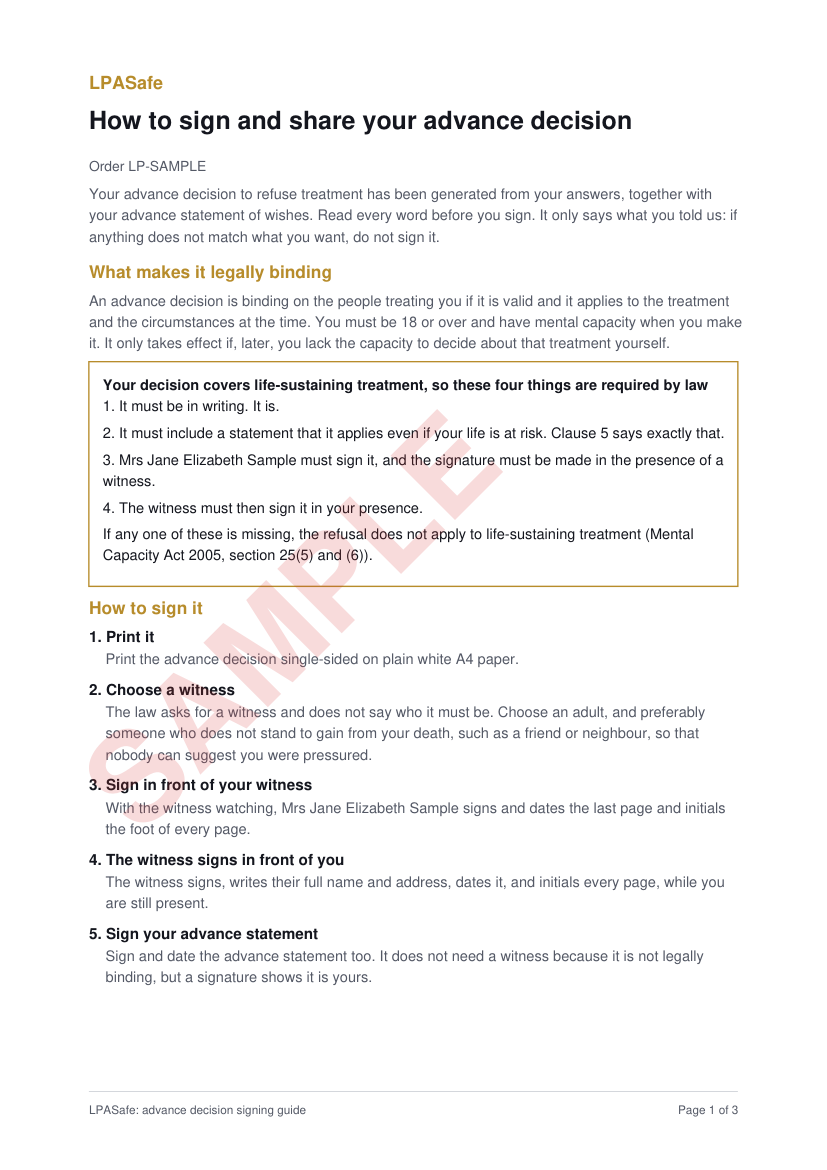
Print it, read every word, then sign and date it in front of a witness, who signs in front of you. Both of you initial each page. The law does not say who the witness must be; an adult who does not stand to gain from your death is the sensible choice. Your guide sets out each step.
- Give a copy to your GP surgery and ask for it to be added to your records.
- Tell the people close to you where the signed original is kept.
- Carry the card from your guide.
- Review it every year or two, and after any change in your health.
Who is told about my advance decision?
Nobody, unless you tell them. There is no register, the NHS will not have it on file unless you share it, and LPASafe does not send it to anyone. An advance decision can only be followed if the people treating you know it exists, which is why your guide lists who should have a copy.
What will LPASafe not do?
- Advise you on which treatment to refuse or what refusing it would mean for you. That is a conversation for your GP or care team.
- Check your choices. The document is generated automatically from what you type; no person and no solicitor reads it.
- Send it to your GP or anyone else, or store it for you beyond the 30-day download links.
- Prepare it for someone who has already lost capacity, or for Scotland or Northern Ireland, where the law is different.
What does the finished document look like?
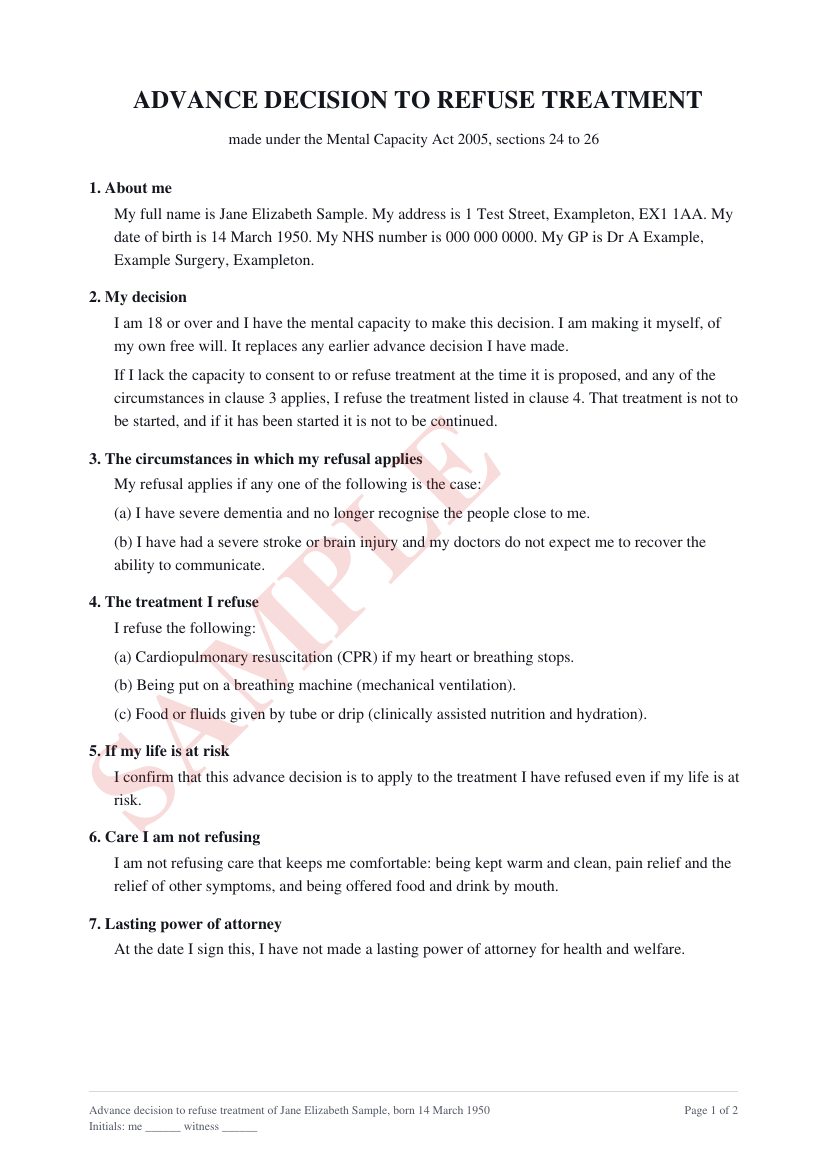
These are real pages produced by the generator from made-up names, stamped SAMPLE. Yours carry your details and no stamp.
Frequently asked questions
Is a living will the same as an advance decision?
Yes. Living will is the everyday name. The Mental Capacity Act 2005 calls it an advance decision to refuse treatment, and the NHS uses both terms. It has nothing to do with the will that deals with your property after you die.
Do I need a solicitor or a doctor to make one?
No. The law does not require either. A doctor does not need to sign it. It is sensible to talk to your GP or care team about what the treatments involve before you decide, because nobody at LPASafe can advise you on that.
Can I get an advance decision for free?
Yes. Compassion in Dying offers a free form and an online service, and Alzheimer's Society publishes a free template. LPASafe charges for setting your own words out in a document that is ready to sign, with a guide. You do not need to pay to make a valid advance decision.
Should I have an advance decision or a health and welfare LPA?
They do different jobs. An advance decision refuses specific treatment and costs nothing to register. A health and welfare LPA appoints people to make care and treatment decisions for you, and costs £92 to register with the Office of the Public Guardian. You can have both, but the order you make them in matters.
Can I change or cancel it?
Yes, at any time while you have capacity. Withdrawing it does not need to be in writing, but tell everyone who has a copy. If you change a decision that covers life-sustaining treatment, the new version must be written, signed and witnessed in the same way.
Who checks the document?
No person does. It is generated automatically from your answers. The form will not produce a refusal of life-sustaining treatment without the statement the law requires, and it checks that you are 18 or over. It has not been reviewed by a solicitor or a doctor.
Does it cover Scotland or Northern Ireland?
No. The Mental Capacity Act 2005 applies to England and Wales. Scotland and Northern Ireland have different law on advance refusals of treatment, and this document is not written for them.
Related pages
Advance decision vs health and welfare LPA
What each does, and why the order you make them in matters.
Health and welfare LPA
Appoint people you trust to make care and treatment decisions for you.
Which LPA do I need?
Property and financial affairs, health and welfare, or both.
Both LPAs together
Many people set up both lasting powers of attorney at once.
Where the facts on this page come from
Checked against the sources below on 12 November 2026. This page has not been reviewed by a solicitor.
- Mental Capacity Act 2005, section 24: advance decisions to refuse treatment (legislation.gov.uk)
- Mental Capacity Act 2005, section 25: validity and applicability
- Mental Capacity Act 2005, section 26: effect of advance decisions
- Mental Capacity Act 2005, section 11: lasting powers of attorney, restrictions
- Mental Capacity Act 2005, section 4: best interests (written statements)
- NHS: advance decision (living will)
- GOV.UK: register a lasting power of attorney (fee)
LPASafe covers England and Wales only. Scotland and Northern Ireland use different systems: see Scotland and Northern Ireland. We are not a law firm and do not give legal advice. The LP1F and LP1H forms are available free on gov.uk.